

 Stories





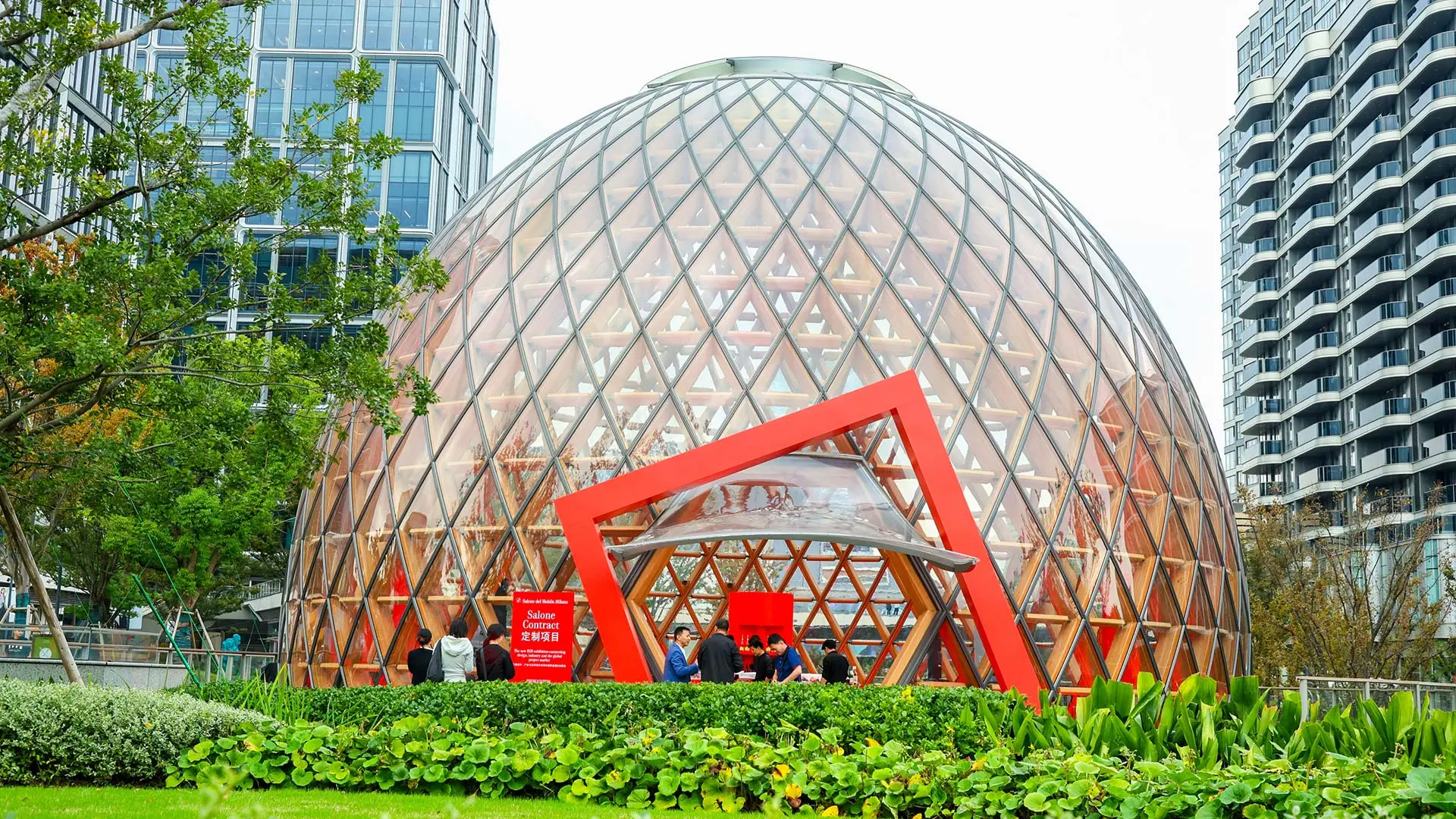
China accounts for 72% of the Asia-Pacific contract market potential

Clessidra table, design Paolo Vernier, 2019; Pippi chairs, design Roberto Paoli, 2019; Siena bookcase, design Balutto Associati, 2021
From the heart of Cordovado to the global markets, Midj combines the excellence of Made in Italy with a management style that redefines the concept of versatility
Midj stands out on the Italian design scene for its ability to produce furnishings suitable for different contexts, from residential to large contract projects. The company’s hallmark is the crosscutting nature of its collections, underpinned by a family business with the human dimension at its heart. With a 24-million euro turnover, Midj now works seamlessly with the retail sector (70%) and a fast-growing contract segment, taking the taste for Made in Italy to more than 70 countries around the world.
Midj’s story is a growth parabola. Brainchild of the entrepreneur Paolo Vernier and his wife Roberta Corazza, the company took its first steps in what was affectionately known as “the chicken coop,” a former farm near Cordovado. After starting out as subcontractors for large brands, the founders have successfully evolved to create their own, solid identity.
Today, the Cordovado headquarters is a production centre of excellence that employs 93 people, 40% of whom are women, a sign of the firm’s attention to equality and human capital. As Miriam Vernier, Head of Sales and Marketing, points out: “We are a family business. Midj has grown, the production area has expanded, but the goal remains to create furnishing accessories that speak a global language.” The figures back this up: exports account for 54%, with France, the United States, Spain and Switzerland at the top of the list of international countries.

Pippi collection, design Roberto Paoli, 2019
A production process developed entirely internally
The secret of Midj’s quality lies in its total control of the production chain. Paolo Vernier is quite clear on this point: “We are somewhat unusual compared with other companies: we want to carry out all the processing internally in order to keep a close eye on it and guarantee high quality. We take care of the details and put our know-how at the designers’ disposal to help them achieve the exact idea they had in mind”.
This approach allows Midj to offer total customisation, a genuine “sartorial” service for architects and interior designers. With a palette boasting 560 fabric variants, 25 colours of metal and 22 colours of plastic, each piece can be tailor-made for the environment it will occupy.

Midj's production department
The Officina delle Idee, Midj’s creative hub
Midj's value lies in its incredible flexibility. The same piece of furniture can be designed to meet different needs: from modern offices to starred restaurants, to luxury hotels and public spaces. This philosophy was shaped in the Officina delle Idee, the beating heart of the business, where Rudy Vernier and his team work on new projects – from analysis and research to market research, by way of collaboration with the community of creatives, right up to listening to direct feedback from its sales representatives.

The building that houses the Officina delle Idee department at Midj's headquarters in Cordovado (Pordenone, Italy)
International recognition
The upshot of this dedication translates into successful collections such as Pippi, Stack, Yak and Leo, products that have graced prestigious locations all over the world, thanks also to collaborations with prominent designers such as Paola Navone, Karim Rashid and Giulio Iacchetti. Over the years, the brand has netted some of the most important international awards, such as the ADI Design Index, the Red Dot Award, the Good Design Award and the German Design Award.
Midj's transversality is evidenced in the contract sector, with outstanding hospitality projects for the Hotel du Bassin in Belgium, the Fresh Hotel in Athens and the historic San Gaudenzio Castle in Pavia, for instance. There is no shortage of bar and restaurant projects such as La Pista in Turin, L’Arbre in Montpellier and the Caffè San Carlo in Turin, and even leisure projects such as the Skybox Udinese Calcio and the Suculenta Port de Sóller in Palma de Mallorca.
Midj’s story demonstrates that a flexible design strategy is an essential tool for navigating change, for consolidating an identity capable of adapting to market challenges by reading the demands of contemporary living.

Showroom Midj