




Organic, modular, entirely without corners or compromise.
Collection: MDEAR
Thought by: DEDON
Category: Sofas and armchairs
Thought by: DEDON
|
Category: Sofas and armchairs
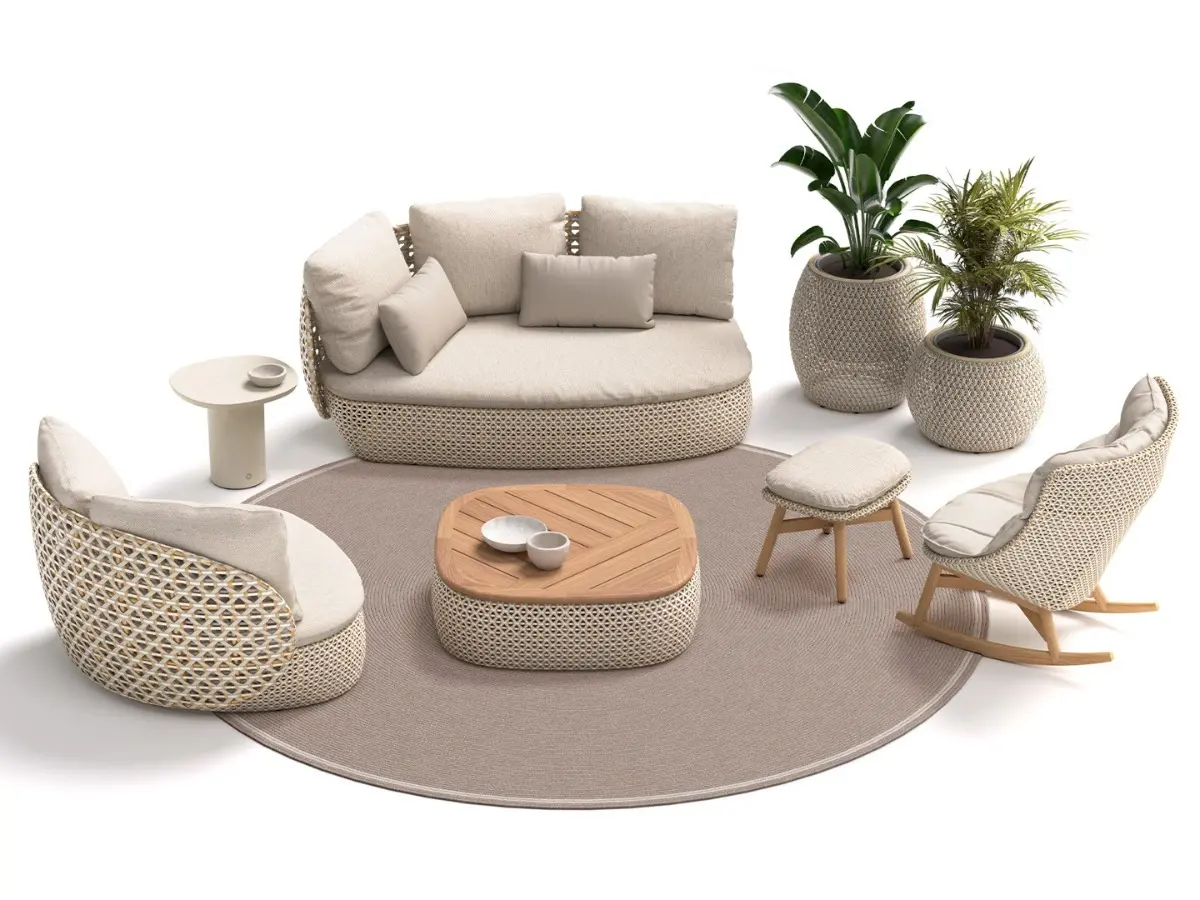
MDEAR is Sebastian Herkner's vision of outdoor islands
Organic, modular, entirely without corners or compromise. Five sculptural lounge modules, each resolved as a standalone piece and each conceived to connect with the others into configurations that range from an intimate gathering for two to a sweeping social landscape for many. The collection introduced a genuinely new category to outdoor living: not a sofa, not a chair, but a system of organic forms that draws people inward and holds them there.
Its surface is immediately recognisable to anyone who knows MBRACE — the iconic triaxial weave, scaled up and reworked for MDEAR's generous proportions, its open and closed geometric rhythm now reading with a bolder, more graphic presence across the curves of a fully woven shell. Made in DEDON Fiber Touch, celebrated for its luxurious softness, the weave carries a tactile warmth that is rare in outdoor furniture — an interior quality brought outside without compromise.
Herkner's starting point was a rejection. A rejection of the right angle, the architectural line, the furniture that imposes its geometry on the people around it. Instead he looked to the natural world — to the curve of a leaf, the sweep of a dune, the bay that shelters without enclosing — and asked what a lounge collection would look like if it followed that logic entirely. The answer was MDEAR: forms with no straight lines, no corners, no concession to the geometry of architecture. Shapes that belong to the world that inspired them.
The second source was social. Herkner observed how people naturally gather outdoors — not in rows, not in lines, but in loose, instinctive clusters that shift as the conversation shifts. MDEAR was designed to follow that instinct rather than override it. Modules that curve toward each other, configurations that open or close around the size of the gathering, a system whose identity is not fixed but alive — responsive to the people using it and the moment they are in.